USA Earnings Calls Schedule — September 03, 2026
1 corporate event is scheduled for September 3, 2026: 1 conference call. Companies on the calendar include LANDS' END, INC..
Automated monitoring and AI summaries for SEC, FDA, EPA, and government filings — delivered to your Inbox.
Stop waiting for end-of-day summaries. Catch catalysts as they happen with an uninterrupted flow of distilled market intelligence.
We monitor global markets in real-time, synthesizing millions of unstructured data points into actionable signals before they hit the mainstream news cycle.
Every material SEC filing, distilled into a decision-ready brief — the company, the event, the AI analysis, the risks — in your inbox seconds after it hits the wire. Swipe through seven we actually sent.
Sentiment: Mixed
Vail Resorts reported a decline in total net revenue for both the three and nine months ended April 30, 2026, compared to the same periods in 2025. Net income attributable to Vail Resorts decreased 19.3% to $314.4M for the quarter and 26.7% to $337.7M for the nine-month period. However, the company reduced total liabilities by $254.1M from July 2025 and improved stockholders' equity by $162.2M over the same period.
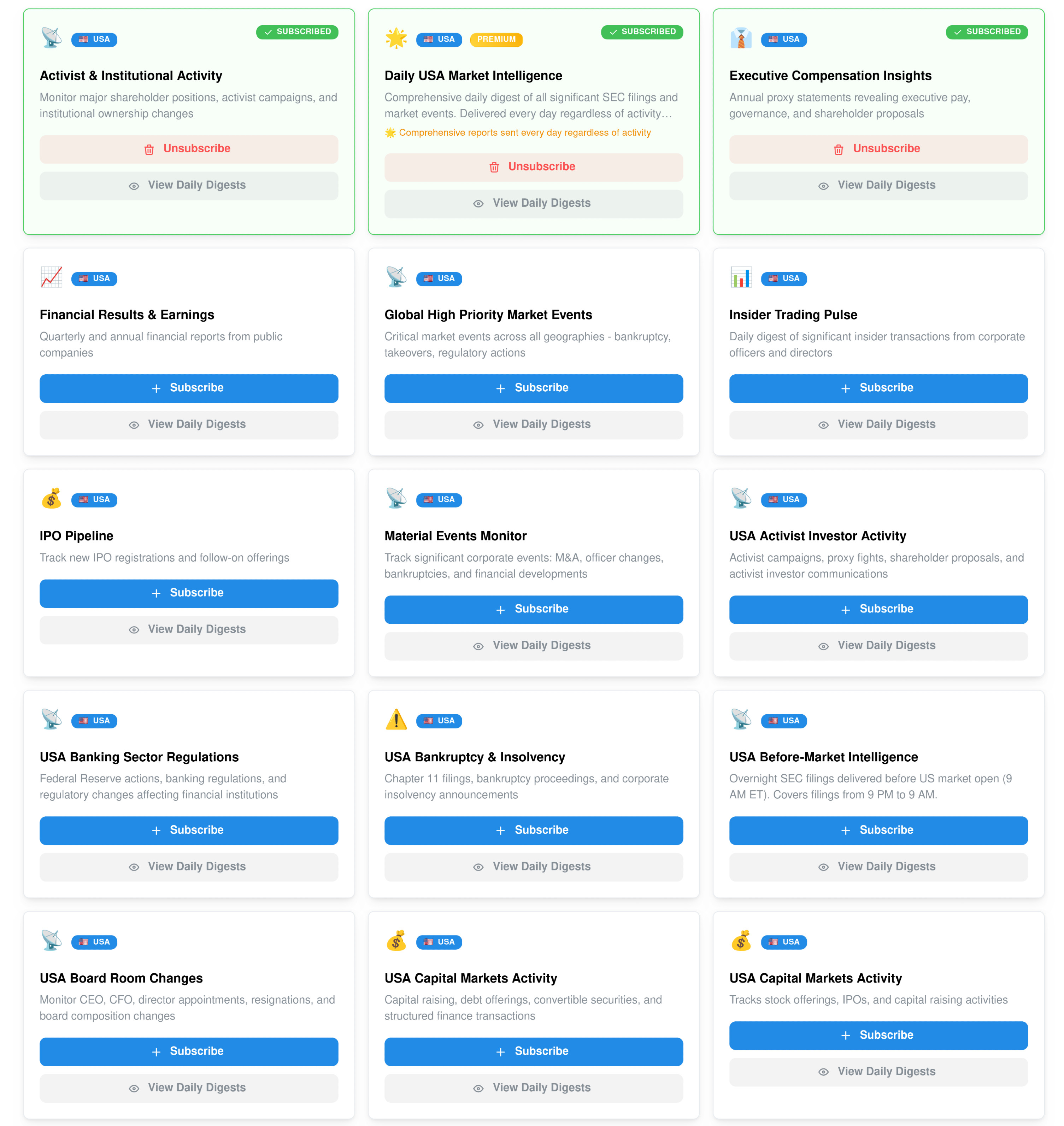
40+ daily digest streams extracted from exchanges and regulatory agencies—automatically summarized, organized, and delivered to your Email inbox, Slack, Telegram or Discord.
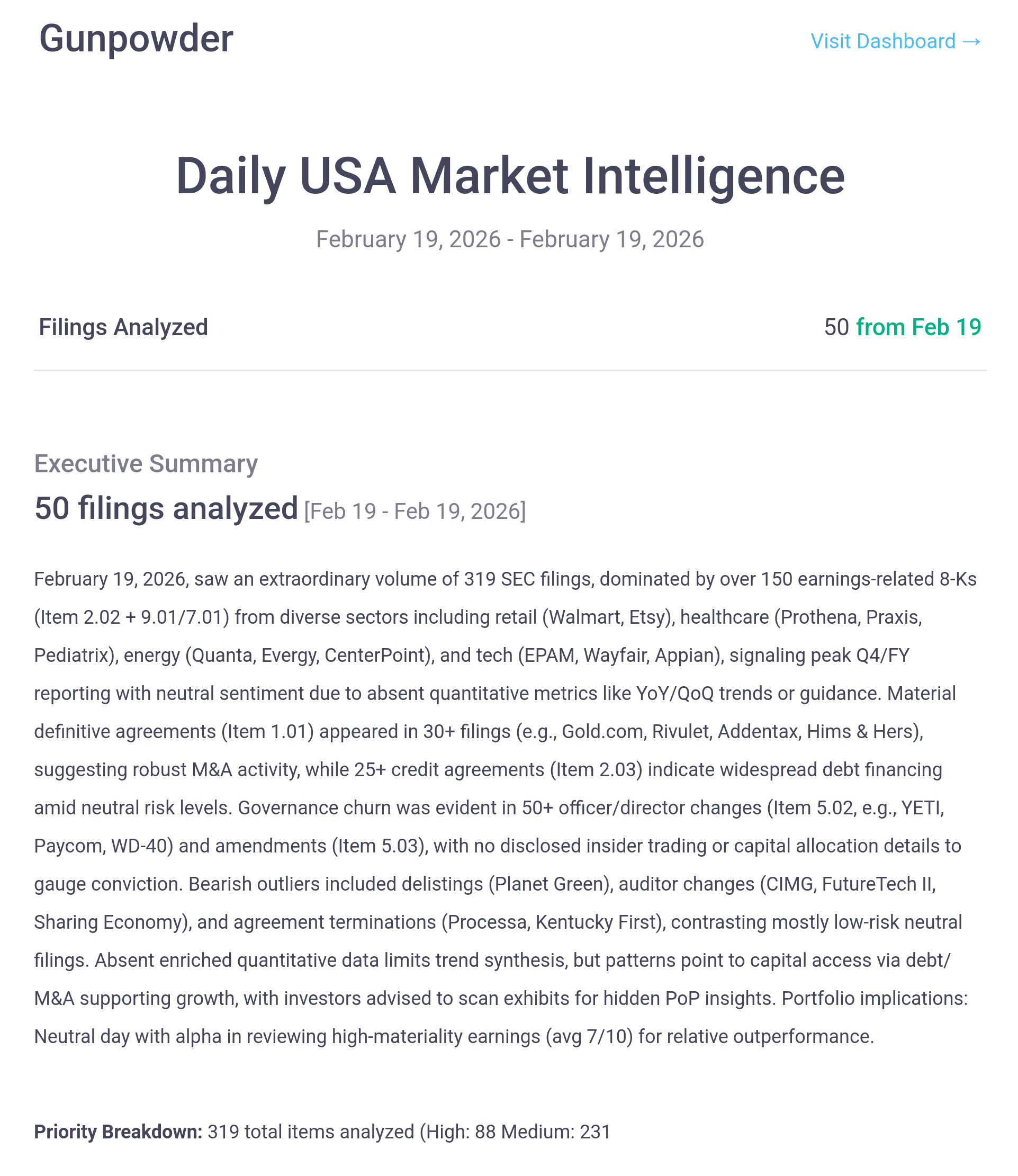
Get concise AI-generated summaries highlighting market impact, sentiment, and key takeaways. Smart analysis sent daily at 9 PM. All AI analysed filings are accessible on the web app 24x7.
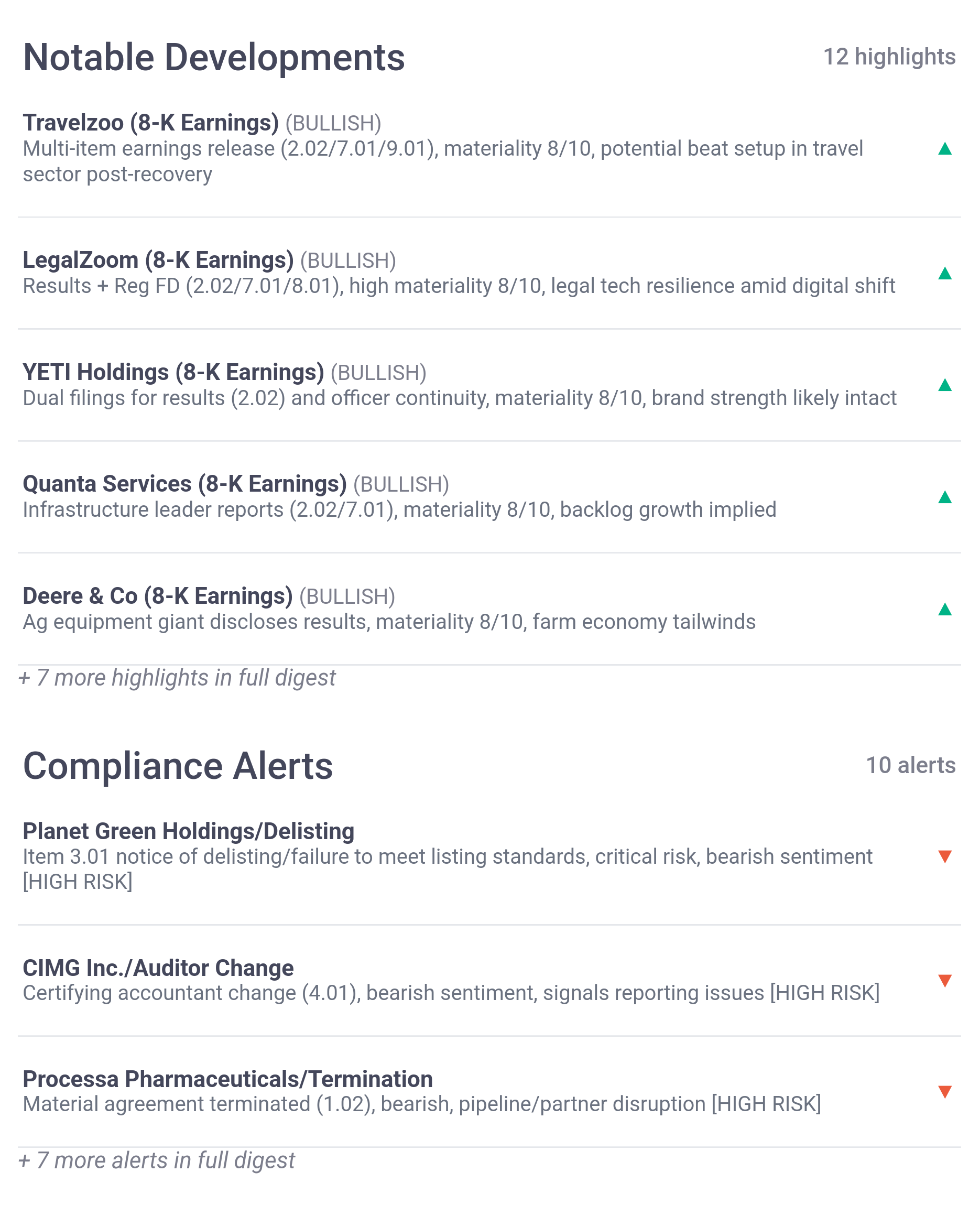
Track investment signals, risks, red flags, insider activity, and notable developments from all exchanges and regulatory agencies from a single platform.
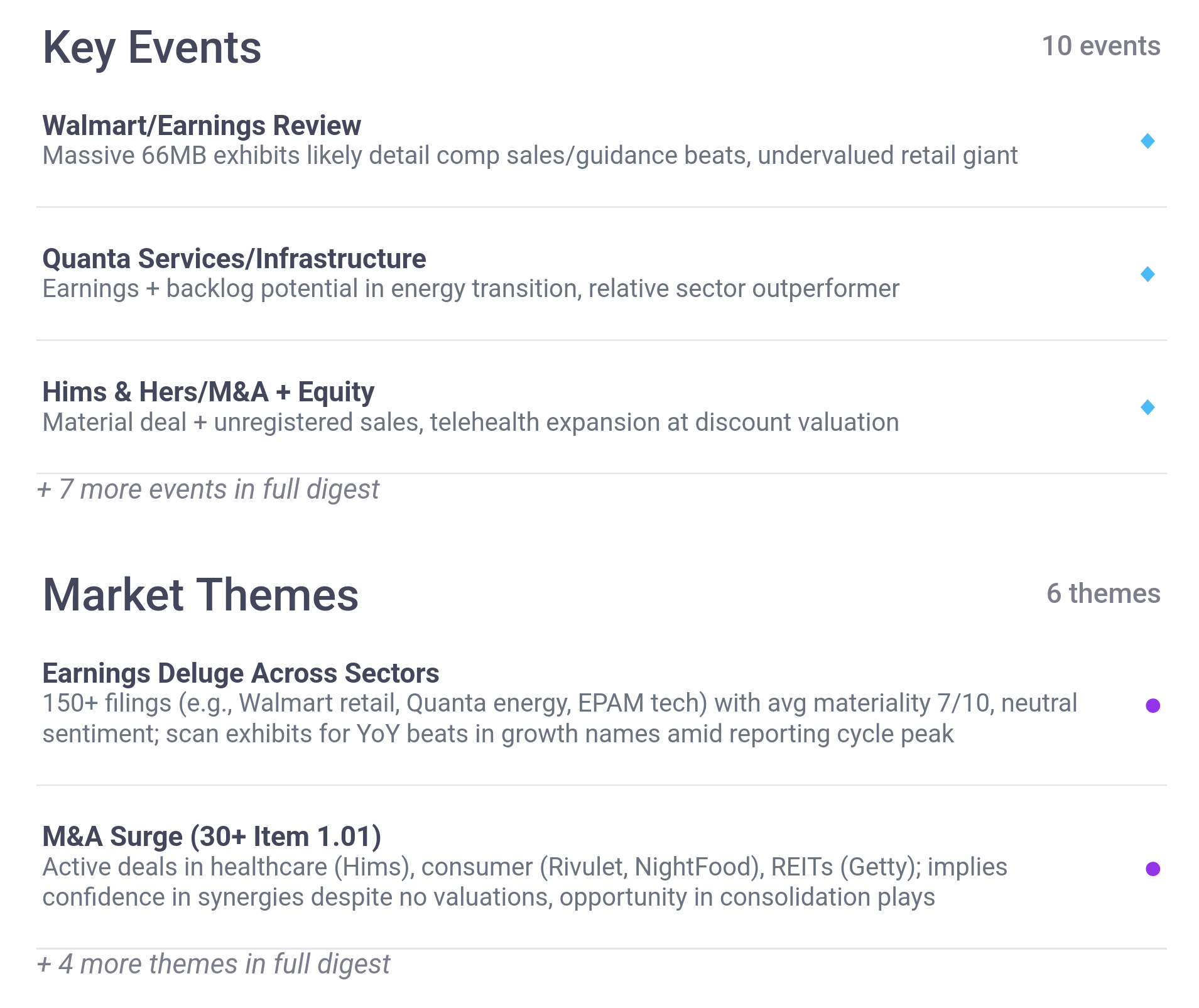
Expert level market theme analysis for investors and traders. Get ahead of the market with our AI-powered key events highlights.
SMART MONEY
Congressional disclosures, superinvestor 13F moves, and corporate insider activity — each scored, themed, and fused into one view. We surface the rare moments when all three lean the same way on the same stock.
Congress
U.S. House & Senate stock disclosures under the STOCK Act — per member, with committee-conflict and late-filing flags, scored 0–100.
Explore →Superinvestors
~70 curated legendary managers — Buffett, Burry, Ackman, Tepper, Dalio — and their quarter-over-quarter position changes and consensus buys.
Explore →Insiders
Corporate insider (Form 4) buys and sells, large executive purchases, and cluster-buy detection above a materiality floor.
Explore →Convergence
The flagship: when two or three independent smart-money sources move the same direction on the same stock inside a 45-day window.
Explore →The convergence signal
When a member of Congress buys, several superinvestor funds add, and corporate insiders buy the same stock inside 45 days — that is a convergence.
Illustrative — a hypothetical pattern, not a recommendation.
SEC filings are long, dense, and time-consuming to read. Gunpowder's AI extracts key information in minutes, so your team can focus on analysis instead of document hunting.
1 corporate event is scheduled for September 3, 2026: 1 conference call. Companies on the calendar include LANDS' END, INC..
This overnight filing cycle is dominated by a surge in SPAC activity, with four major business combination announcements (PlusAI, Remix Therapeutics, Ursa Major, Elroy Air) signaling a potential resurgence in the de-SPAC market. A significant capital allocation theme emerges from large-scale share repurchase programs at Toyota (JPY 1 trillion) and ORIX (¥250 billion), indicating strong corporate confidence in undervaluation. The biotech sector presents a stark contrast, with Passage BIO's cash-burning pre-revenue status and a major licensing deal between HUTCHMED and GSK, highlighting the sector's binary risk/reward profile. Insider selling is concentrated in the technology sector, with multiple executives at Rackspace Technology and RxSight reducing their holdings, which warrants caution. A notable related-party acquisition by Scienjoy Holding and a highly dilutive financing structure for Ribbon Acquisition Corp. present complex risk/reward scenarios for investors.
This digest covers 11 FDA approvals from a single day (September 2, 2026), all classified as 'Other' (non-NME, non-biosimilar, non-label-expansion) with a mix of 3 bullish and 8 neutral signals. The period is dominated by generic/biosimilar-style approvals for established molecules (POMALIDOMIDE, FINERENONE, HYDROCORTISONE, EMTRICITABINE) from sponsors like CIPLA, SANDOZ, APOTEX, and NATCO, signaling continued commoditization pressure in small-molecule and specialty generics. The highest-conviction signals are two NME approvals with Priority Review and Orphan designations: DARAXONRASIB (RASONQUE) from REVOLUTION MEDICINES INC and an undisclosed NME from PRIOVANT THERAPEUTICS INC, both representing high-value, targeted oncology/rare disease opportunities with significant commercial upside. Key risks include the lack of disclosed commercial data (peak sales, pricing, exclusivity) for all approvals, and the potential for IRA negotiation exposure for any small-molecule NMEs that achieve blockbuster status.
In the period from August 26 to August 28, 2026, the FDA approved three New Molecular Entities (NMEs) under Priority Review and Orphan Drug designations, all flagged as bullish signals with high materiality. The approvals span Takeda Pharmaceuticals’ RUSFERTIDE ACETATE (MIMRYLO), an undisclosed NME from Priovant Therapeutics, and Revolution Medicines’ DARAXONRASIB (RASONQUE). While no specific therapeutic area clustering is confirmed due to limited data, the concentration of NMEs with Orphan and Priority Review status signals a strong regulatory tailwind for targeted, high-unmet-need therapies. The highest-conviction signal is DARAXONRASIB from Revolution Medicines, given its potential in RAS-mutant cancers—a historically difficult target—and the sponsor’s focused oncology pipeline. A key risk is the lack of disclosed peak sales estimates, pricing power, or exclusivity details, limiting near-term commercial valuation assessments.
The September 2, 2026, FDA approval stream for Big Pharma sponsors delivered 8 approvals, all classified as 'Other' (no NMEs, biosimilars, or label expansions per the provided mix), yet all 8 carry bullish signals. The dominant theme is HIV and metabolic franchise expansion, with Gilead Sciences receiving four label expansions (lenacapavir, bictegravir/lenacapavir, and one undisclosed) and Eli Lilly receiving two for tirzepatide (Mounjaro), while Takeda's rusfertide acetate (Mimrylo) stands out as the highest-conviction signal—an NME with Priority Review and Orphan designation, indicating strong unmet need in a rare disease. Janssen's ustekinumab (Stelara) label expansion adds to the bullish mix. Key watch items include the lack of disclosed commercial data (peak sales, exclusivity, pricing) and the potential for IRA negotiation exposure on small molecules like tirzepatide and bictegravir/lenacapavir, which could pressure long-term revenue. Overall, the period signals robust franchise management and pipeline execution across major sponsors, but investors should seek clarity on the specific indications and commercial potential behind these approvals.
During the period of September 2, 2026, the FDA approved four orphan-designated drugs, all classified as 'Other' (non-NME, non-biosimilar, non-label-expansion), generating four bullish signals. The dominant theme is a high-conviction oncology and precision medicine cluster, with two NME approvals (RUSFERTIDE ACETATE from Takeda and DARAXONRASIB from Revolution Medicines) receiving Priority Review and Orphan Drug status, signaling strong unmet need and premium pricing potential. The highest-conviction signal is DARAXONRASIB (RASONQUE) from Revolution Medicines, a targeted RAS inhibitor with breakthrough potential in KRAS-mutant cancers, supported by Priority Review and Orphan designations. A key risk is the lack of disclosed commercial data (peak sales, pricing, exclusivity) for all four drugs, creating uncertainty in revenue forecasting and market positioning.
The September 2, 2026 FDA approval stream featured 14 approvals, all classified as 'Other' (no NME, biosimilar, or label expansion designations in the provided data, though several approvals carry NME, biosimilar, or label expansion characteristics). The period was dominated by biosimilar and generic-type approvals, with notable NME approvals for Takeda's RUSFERTIDE ACETATE (MIMRYLO), Priovant's undisclosed NME, and Revolution Medicines' DARAXONRASIB (RASONQUE), all with Priority Review and Orphan designations. The highest-conviction signal is DARAXONRASIB, a targeted oncology therapy for KRAS-mutant cancers, which could be a significant commercial opportunity for Revolution Medicines. Key risks include the lack of commercial data (sales estimates, pricing) across all approvals, and the potential for biosimilar competition to erode originator revenues for drugs like POMALIDOMIDE, FINERENONE, and EMTRICITABINE. Investors should monitor launch execution and payer coverage for the NMEs, as well as the competitive impact of biosimilars on existing franchises.
Over a single-day period, the Department of Veterans Affairs awarded one contract totaling $143.6 million to Oracle Health Government Services, Inc. for data migration services under the VA’s Electronic Health Record Modernization (OEHRM) program. This is a purely civilian award with no defense exposure, reflecting the VA’s continued investment in IT modernization. The contract is a firm-fixed-price, non-competitive delivery order with a performance period that ended in November 2021, meaning it has no current revenue relevance. The highest-conviction signal is neutral: the sole-source relationship suggests Oracle’s entrenched position, but the expired contract and lack of competition data limit actionable investment implications. Key risk is the absence of any re-compete or follow-on award data, leaving Oracle’s competitive moat unconfirmed for future VA IT contracts.
This digest covers three federal contracts totaling $633.7 million, all awarded to civilian agencies with zero defense-related exposure, signaling a pure civilian-sector procurement theme. The dominant award is a $365.4 million cost-plus delivery order to Booz Allen Hamilton from the GSA for IT systems design, representing 58% of total obligation and carrying moderate execution risk due to 167 subawards. A $143.6 million sole-source VA data migration contract to Oracle Health Government Services is likely completed, offering limited current revenue relevance. The $124.7 million NASA modification to Vertex Aerospace lacks detail, reducing conviction. Key risk: Booz Allen's contract nears expiration in April 2024, creating recompetition uncertainty. Highest-conviction signal is neutral, with no bullish or bearish extremes across the set.
This digest covers three significant contract modifications totaling $633.7 million, all from civilian agencies with zero defense-related awards, signaling a clear civilian-sector focus for the period. The dominant theme is federal IT modernization, led by a $365.4 million Booz Allen Hamilton cost-plus award from GSA for IT systems design, which represents the highest-conviction signal due to its size and ongoing federal priorities. However, the Booz Allen contract's negative outlayed amount and heavy subaward reliance introduce execution and margin risks, while the $143.6 million Oracle Health VA contract is largely historical (completed in 2021) and offers limited current relevance. The $124.7 million Vertex Aerospace NASA modification lacks sufficient detail for actionable analysis, but the aggregate neutral signal strength (5.3/10) and lack of bullish or bearish signals suggest a stable but unexciting investment landscape for government services contractors.
The three contracts analyzed represent $633.7 million in total obligations, all from civilian agencies (GSA, VA, NASA), with zero defense-related awards. The dominant theme is federal IT modernization, led by Booz Allen Hamilton's $365.4 million GSA delivery order for IT systems design, which carries the highest materiality (7/10) but shows a negative outlayed amount, signaling potential de-obligation risk. Oracle Health's $143.6 million VA data migration contract is likely completed, offering limited current relevance, while Vertex Aerospace's $124.7 million NASA modification lacks detail. The highest-conviction signal is the continued civilian IT spending, though execution risks and lack of defense exposure temper enthusiasm. Key watch items include Booz Allen's contract recompetition and resolution of its negative outlay.
FAQ
Gunpowder monitors all major SEC filing types including 10-K (annual reports), 10-Q (quarterly reports), 8-K (current reports), DEF 14A (proxy statements), 13-F (institutional holdings), and many more. Configure your alerts to focus on the filing types relevant to your research or compliance needs.
New filings are processed within minutes of being published to agency databases. AI summaries typically complete within 2-5 minutes, depending on document length. You will receive alerts shortly after processing is complete.
Yes! Beyond SEC filings, Gunpowder also monitors filings from the FDA, FCC, EPA, and other regulatory agencies. This gives you a comprehensive view of regulatory activity in one place.
Our AI reads through entire filings and extracts key information, including risk factors, notable disclosures, and important changes. The summaries are designed to give you the key takeaways in under 60 seconds.
Gunpowder integrates with Slack, Discord, email, and webhooks for alerts. We also offer API access for custom integrations with your existing workflow, CRM, or internal tools.
Yes, we offer a 14-day free trial with full access to all features. No credit card required. You can set up alerts for multiple companies and agencies during your trial period.